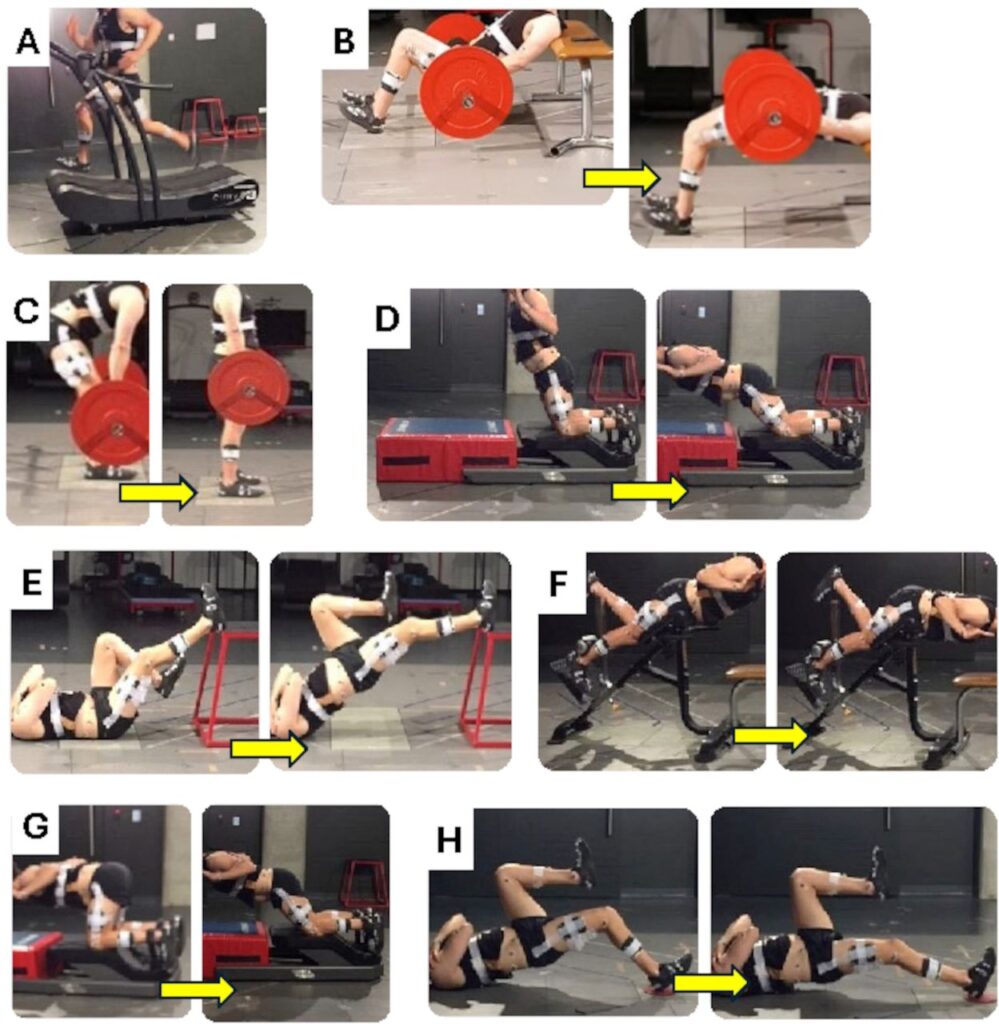
Objectives :To compare the force and stretch demandsexperienced by the hamstrings during seven resistance
training rehabilitation exercises and progressively increasing running speeds
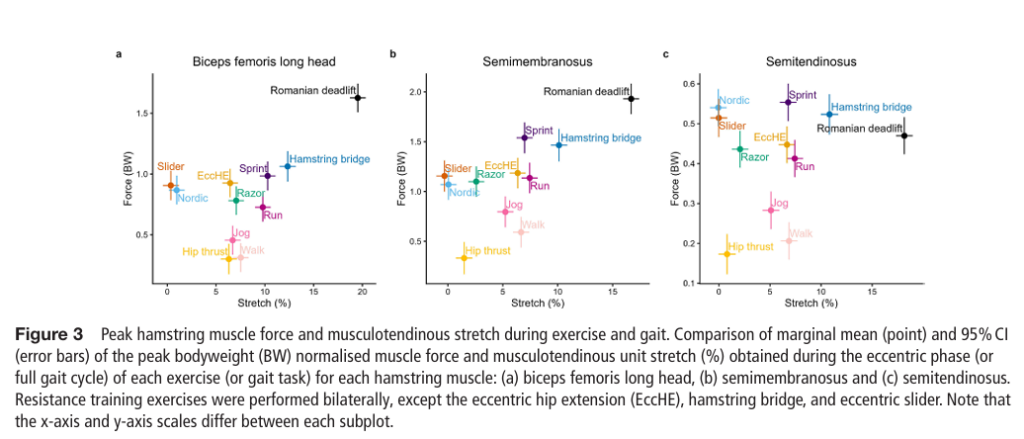
Results : The bilateral Romanian deadlift (RDL) produced significantly greater peak force in the BFlh (1.6BW,95% CI 1.5 to 1.7) and SM (1.9BW, 95% CI 1.8 to 2.1) than any other resistance training or gait task (p<0.001).
Four resistance training exercises generated peak BFlh forces that were not significantly different (p≥0.433)
to maximum speed sprinting (1.0 BW, 95% CI 0.9 to 1.1): unilateral hamstring bridge (1.1 BW, 95% CI
0.9 to 1.2) and the unilateral eccentric hip extension, unilateral eccentric slider and Nordic hamstring exercise
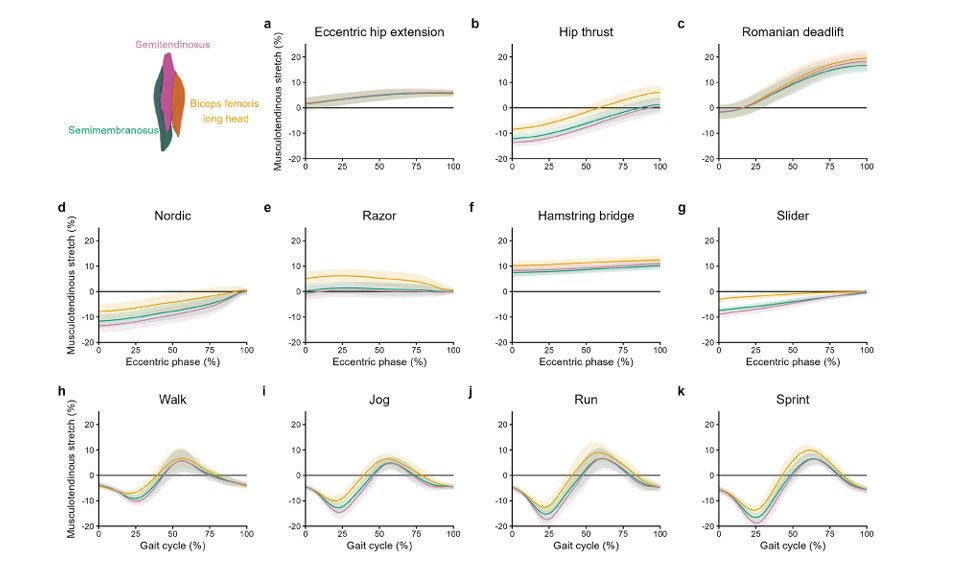
(NHE) (all 0.9 BW, 95% CI 0.8 to 1.0). The RDL and unilateral hamstring bridge produced significantly greater
peak stretch than any other task for BFlh, SM and ST (p<0.001), while the NHE and unilateral eccentric slider
produced significantly lower stretch than any other task (p<0.001), except the hip thrust for the ST (p≥0.143).
Conclusions : The force and stretch demands experienced by the hamstrings during common resistance
training exercises ranged from less than walking (eg,hip thrust) to more than sprinting (eg, RDL). However,
differences between exercises and running tasks depended on the specific muscle investigated. Our results
inform exercise selection strategies for hamstring injury prevention and rehabilitation.